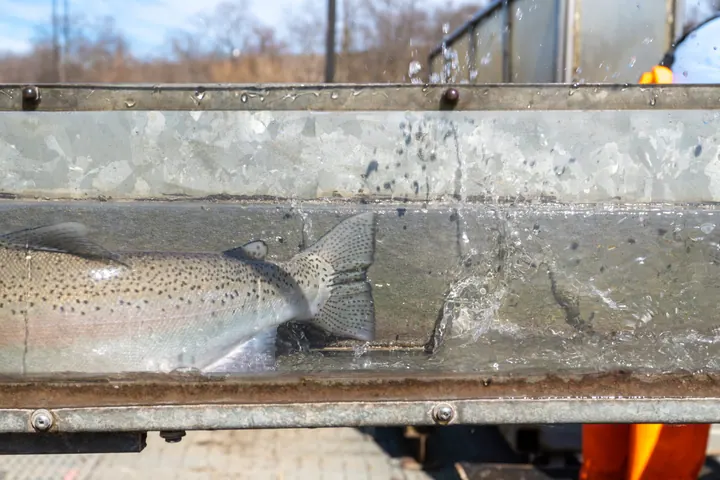
26,503 fish sounds like the kind of number you put in a headline when an ecosystem is recovering.
That is how many fish Royal Botanical Gardens staff handled at the Cootes Paradise Fishway in 2025. But the Fishway is not a turnstile where more fish automatically means a healthier marsh.
It is a checkpoint designed to do two jobs at once: keep large common carp out of Cootes Paradise and allow staff to move, count and study native fish travelling between Lake Ontario and spawning habitat.
- 26,503 fish were handled at the Fishway
- White sucker became the most abundant recorded species for the first time
- Bowfin and white sucker increased
- Common carp, goldfish, rudd and brown bullhead declined
- More than 100 salmon were observed spawning upstream in Spencer Creek
The species matter more than the total
A restored marsh should not simply contain a lot of fish. It should support a healthier mix of native species.
That is why RBG's comparison between Grindstone Marsh and Cootes Paradise matters. Grindstone was dominated by native fish such as sunfish. Cootes Paradise remained much more heavily influenced by introduced Eurasian species, especially goldfish.
The Fishway can stop large adult carp from entering. It cannot control the water conditions that decide which young fish survive once they are inside the marsh.
Bad water can make the wrong fish look successful
During hot summer periods, excess nutrients and decomposition can push dissolved oxygen close to zero.
Goldfish tolerate those conditions unusually well. Many native species do not.
That creates a strange result: the marsh can produce enormous numbers of young fish while still favouring species that are better adapted to degraded conditions.
Then a much older habitat started returning
For part of June and July 2025, aquatic plants spread across Cootes Paradise from end to end for the first time since the 1930s.
That may be the more hopeful signal. Aquatic vegetation provides habitat, stabilizes sediment and can help shift the marsh toward a healthier state.
The change was not untouched by summer. Heat brought large rafts of algae, but RBG expects many of the plants to survive and continue expanding.
The Fishway can fix one bottleneck, not an entire watershed
The structure is very good at controlling carp and measuring migration. It cannot stop nutrient loading, repair every upstream water source or guarantee enough oxygen through the hottest part of summer.
The 26,503 figure is useful, but it is not a score. The more useful next number is whether native species keep gaining on goldfish — and whether the aquatic plants that returned in 2025 survive another hot summer.