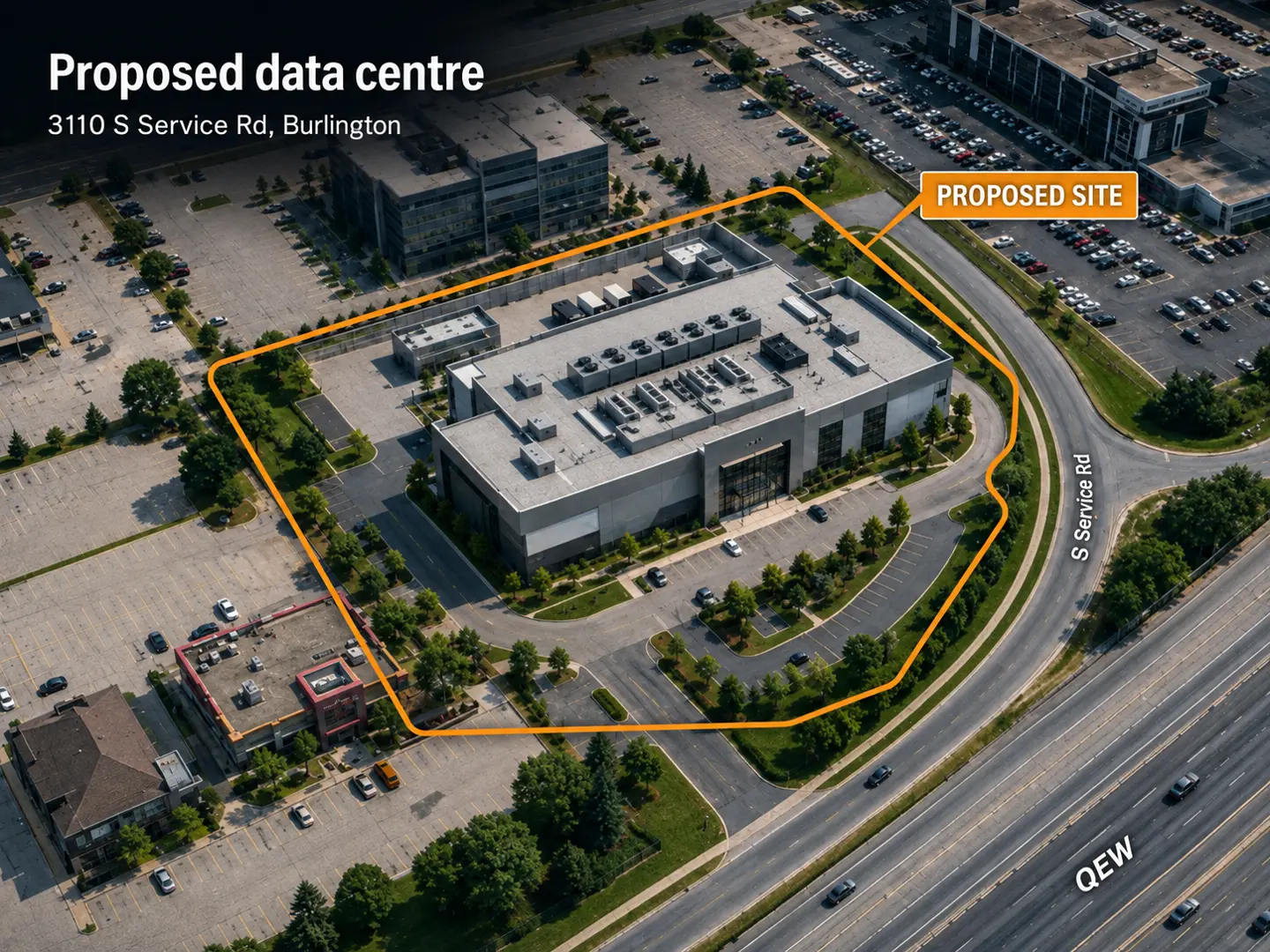
Start with the part that has caused the most confusion: Burlington's proposed data centre is not, based on the application now before the City, a purpose-built AI hyperscale campus.
The proposal is for a two-storey, roughly 5,163-square-metre facility at 3110 South Service Road, the former Tucker's Marketplace site. The applicant says it would provide colocation, cloud computing, data storage, network infrastructure and data-processing services. The City says it would need about 20 megawatts of electrical capacity: roughly 17 MW for the data-centre load and another 3 MW for general use.
That is much smaller than the 100-MW-plus AI campuses Burlington itself uses as a comparison. It is also proposed to be air cooled rather than built around the liquid-cooling systems increasingly associated with high-density AI hardware.
So what is actually being approved?
This is a site-plan application, file 535-004/26. Data centres are already a permitted use in this employment area, so the basic question of whether this type of use can exist here was settled by Burlington's existing planning rules.
That changes the approval process. City staff, not council, review the technical details: where the building sits, vehicle movement, servicing, landscaping, accessibility, safety and how the site functions. The City says council cannot simply order staff to reject an otherwise permitted use.
It also means this is not a normal public rezoning hearing where opposition can determine whether the use is allowed. Residents can still raise broader concerns, and the City says it wants to understand community needs as it develops future data-centre policy, but this particular site-plan review is narrower.
The questions that still matter
A 20-MW facility is still an industrial-scale electrical load. Burlington has already told the province that local electricity capacity can constrain growth and that data centres should be considered in the context of available capacity, land-use compatibility, employment yield and community benefit.
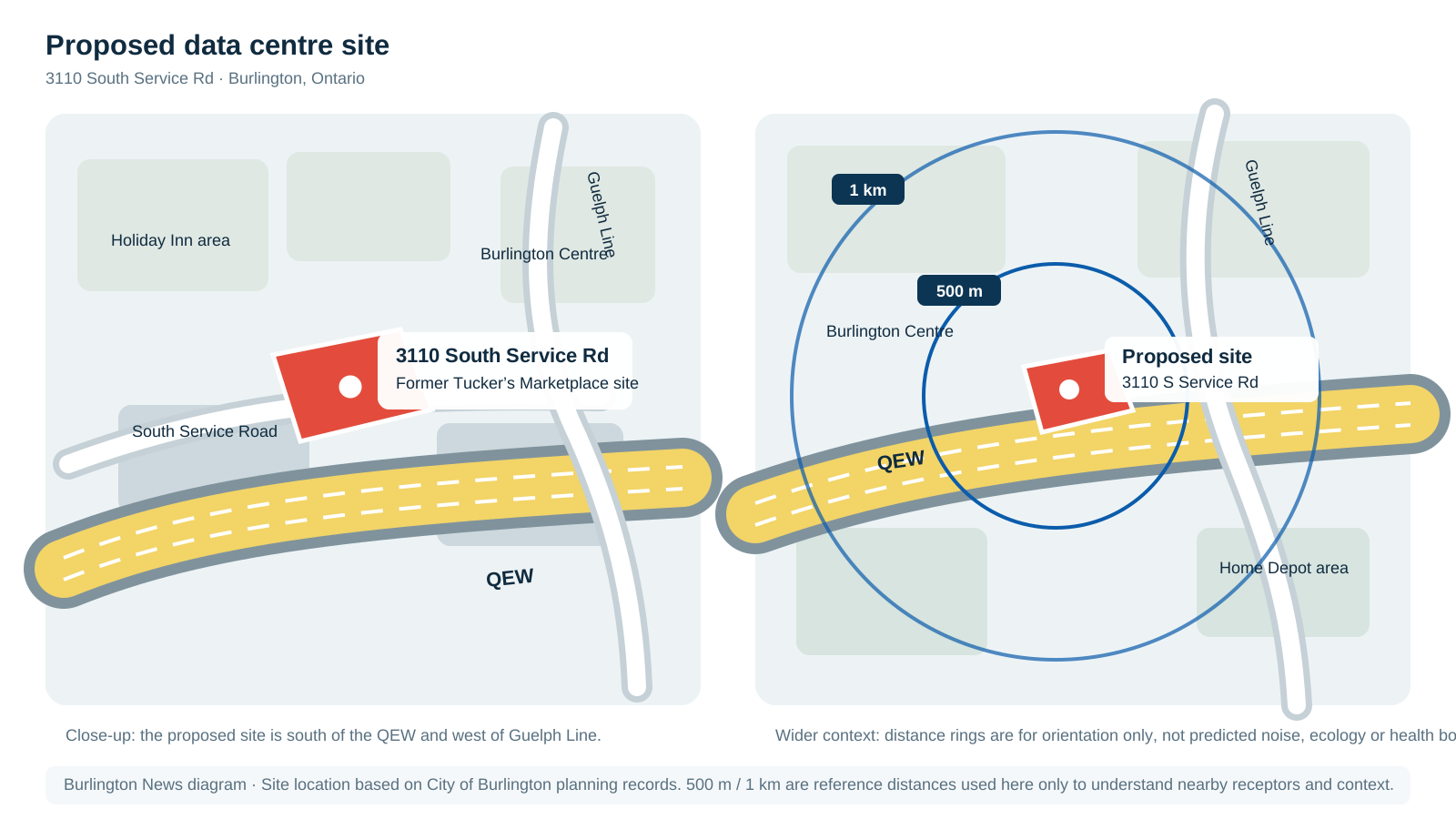
There are also practical questions that cannot be answered by the label “general-purpose data centre.” Residents reasonably want to know how much sound will come from cooling equipment and standby generators, how often emergency generators would be tested, what the closest sensitive receptors are, what traffic the completed facility would generate and what mitigation would be required.
Those questions are site-specific. There is no scientifically honest universal “data-centre impact radius.” Sound falls with distance and depends heavily on the equipment, building envelope, barriers and operating conditions. Ontario's own industrial-noise framework illustrates why distance matters: in some environmental approvals, being at least 1,000 metres from the nearest point of noise reception can satisfy a setback screening criterion. Facilities closer than that are not automatically unsafe; they simply need more detailed assessment rather than a one-size-fits-all conclusion.
What about water and ecology?
This is where the project's cooling design matters. Research on data centres shows that water use varies enormously depending on server efficiency, climate, electricity source and especially the cooling system. Some water-cooled facilities can consume substantial volumes onsite. Air-cooled systems generally shift more of the burden toward electricity rather than direct cooling-water consumption.
Burlington says this proposed facility is expected to be air cooled. That makes it a poor fit for headlines about giant evaporative-cooling campuses drawing enormous volumes of municipal water.
But there is still an environmental chain to consider. Data centres use electricity continuously. Depending on how that electricity is generated, the indirect water and emissions footprint can be larger than what happens at the building itself. Recent research has also raised concerns about the cumulative effects of expanding data-centre electricity and water demand on freshwater ecosystems. None of that proves this Burlington project will harm a specific creek, wetland or neighbourhood. It explains what the technical review should measure instead of assuming the answer in advance.
Hamilton shows why the distinction matters
Just down the QEW, Hamilton has been wrestling with a very different proposal: an AI-focused data-centre concept connected to the Steelport lands on the industrial waterfront. That project helped trigger protests, expert hearings and a debate over whether Hamilton should temporarily pause new AI data centres while it writes stronger rules.
Hamilton ultimately voted down a one-year moratorium in July, after previously advancing the idea. Earlier, a land-severance application related to the proposed project had also been denied.
The Hamilton fight should not be pasted onto Burlington as though the projects are identical. The scale, location, cooling design and intended use all matter. What Hamilton does show is how quickly municipalities are being forced to write rules for a class of infrastructure that can range from a relatively modest colocation building to a power-hungry AI campus several times larger.
Burlington is already looking beyond this one application
The City's own data-centre work now goes beyond 3110 South Service Road. Burlington has identified electricity capacity, land-use compatibility, jobs and community benefit as policy questions and has called for better provincial-municipal coordination.
That may be the most important part of the story. The South Service Road proposal is not the giant AI campus some residents imagined. But it arrived early enough that Burlington is now having to decide what rules should apply if a much larger proposal comes next.
For this site, the useful questions are specific: what equipment will be installed, what sound will reach the nearest homes and businesses, what electrical upgrades are required, what emergency-generation regime is proposed, and what mitigation City staff and outside agencies require before approval.
“It's not an AI hyperscale centre” answers one question. It should not be used to avoid the rest.
Sources
- City of Burlington: 3110 South Service Rd. application and FAQ
- City of Burlington: Data Centres
- Ontario: industrial noise setback screening guidance
- npj Clean Water: Data centre water consumption
- Resources, Conservation & Recycling: review of data-centre workload water use
- CHCH: Hamilton council vote on an AI data-centre moratorium
- CHCH: Steelport AI data-centre proposal in Hamilton