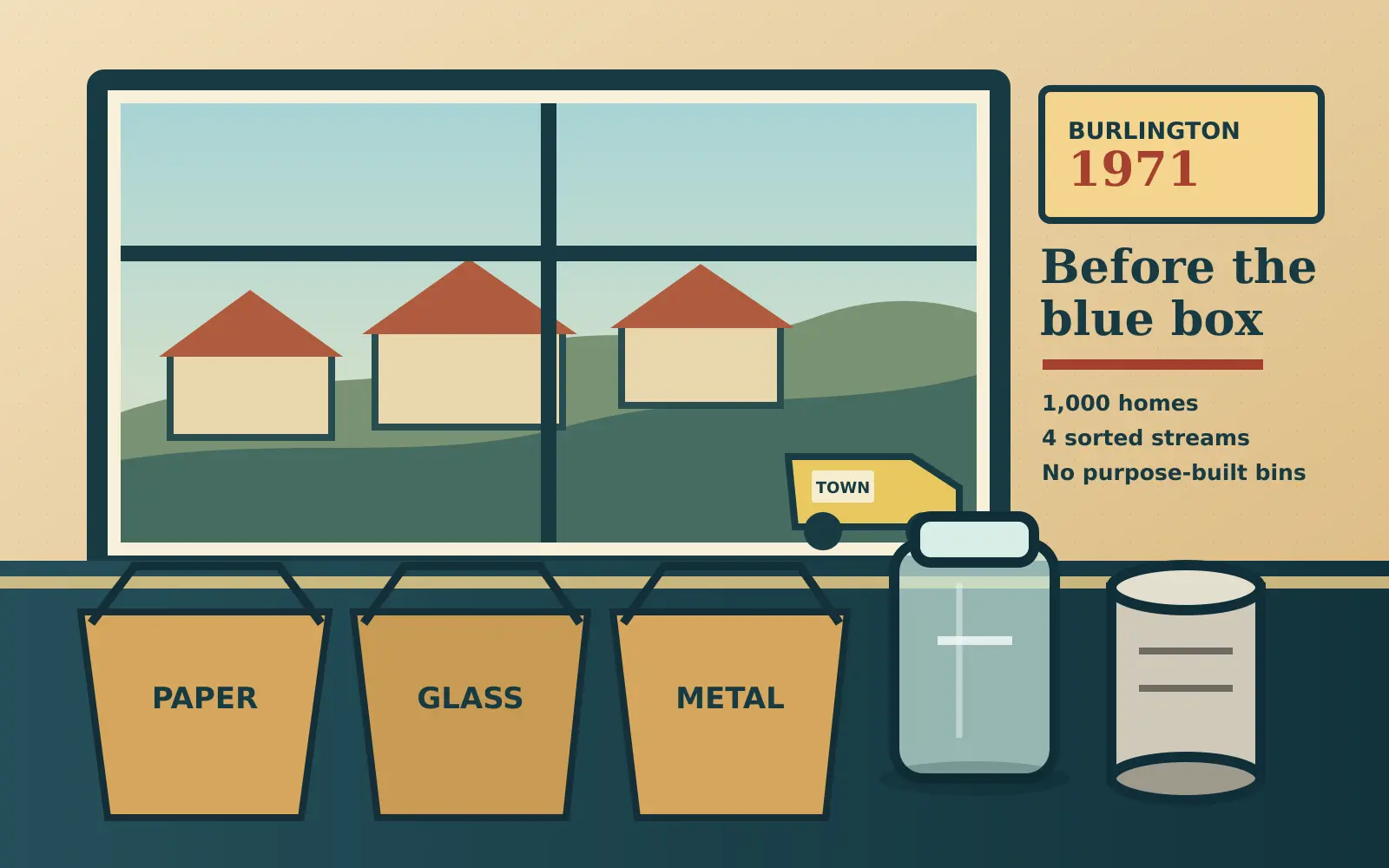
On Aug. 25, 1971, a second collection vehicle followed Burlington's regular garbage truck through a test neighbourhood east of Guelph Line. It was looking for four things residents had been asked to keep out of the garbage: newspapers, metal cans, clear glass and coloured glass.
The town had not given most households purpose-built containers. Residents had to rinse, sort and store four streams themselves, then remember to carry out only what they had accumulated. There was no large promotional campaign and no rule requiring anyone to participate.
Ontario wanted clean data. What it got was an argument.
A door-to-door survey found 89 per cent of households willing to cooperate. On individual collection days, detailed counts sometimes found material outside as few as 14.5 per cent of the homes. Newspapers soon described the experiment as a failure, according to the citizens' committee that helped run it.
But a family did not need to put out a can or jar every Wednesday to be recycling. When participation was measured across several weeks, the volunteers calculated that roughly 70 per cent of households had taken part.
The gap was the experiment's real finding. Burlington had not discovered that residents refused to recycle. It had discovered how hard it was to measure, collect and finance recycling when the system depended on inconvenience.
The jar and can that would not go away
The curbside study began with a smaller question in an Aldershot kitchen.
In a 2017 Burlington Post interview, Roberta McGregor, then known as Roberta Golightly, recalled finishing the dishes in the spring of 1970 and noticing a pickle jar and a can on the counter. “Where are these going to go?” she wondered.
McGregor called Stelco about cans, Dominion Glass about bottles and jars, and Mill Paper Fibre about newspaper. All three would accept material if the volunteers could sort and deliver it. Her church discussion group surveyed 300 Aldershot households, handed paper grocery bags to those who joined, and arranged pickup on two consecutive Saturdays.
The two-week test did not end after two weeks. Recyclables began appearing on McGregor's driveway. Eighteen women formed the core of the Citizens' Committee for Pollution Control, or CCPC. Their network eventually reached 21 neighbourhood depots, according to the Post's interviews with McGregor and co-founder Mary Jane Boelhouwer.
Before the group found a volunteer with a truck, personal vehicles carried loads of paper, glass and metal over the Skyway to Hamilton industries. In February 1971, Burlington supplied an old house on Brant Street as a sorting centre. A contemporary Burlington Post headline called it “first in Canada.” The building soon proved too unstable for the volume passing through it, and the operation moved to an empty public works garage on Guelph Line.
The citizen system solved one part of the problem: people would separate useful material. It did not solve who should collect it from every home or who should pay when selling the material failed to cover the cost.
Ontario turns a neighbourhood into a laboratory
CCPC asked the town for separate collection. Burlington Council instead asked the province to study the idea and agreed to pay 20 per cent of the project cost. The final budget was about $25,000.
The study area was designed as a small version of Burlington. It included detached homes, townhouses, apartments and seniors' cottages, all inside the same Wednesday garbage route. The planned sample was approximately 1,000 dwelling units and 4,000 people, about five per cent of the town's population at the time.
Students and CCPC volunteers went door to door at the end of July. They reached 84 per cent of the area and found the 89 per cent willingness rate. One week before collection began, volunteers returned with instructions describing how to prepare each material.
Then the test deliberately withheld the conveniences that later became normal. The province's 1972 final report says there was no serious participation campaign and no properly designed container for most homes. The request to separate several categories was, in the report's own description, unrealistic for a normal operation. Ontario wanted to see what happened without inducements.
Problems appeared immediately. A follow-up instruction sheet went out five days after the first pickup. A public meeting after three weeks attracted fewer than 20 people, including officials. Two apartment buildings were selected, but collection began in only one after negotiations with its manager and superintendent. That building received marked containers in its parking lot and, later, a large box for newspaper.
The apartment result hinted at what support could change. In comments attached to the final report, CCPC said that building was still separating about 700 pounds of material a week when the report was written.
Three numbers, three different stories
These figures measure intention, one-day set-outs and participation over time. They are not directly interchangeable.
Ontario's consultants treated material at the curb as demonstrated support. By that measure, participation was at least 50 per cent lower than residents had promised in interviews. The test also found that collecting, storing and transporting the recovered material cost more than four times the revenue it produced.
Projected across Burlington, the consultants estimated that the program would increase net collection costs by 40 to 50 per cent while reducing landfill demand by 10 per cent or less. Newsprint and mixed-metal cans also presented market problems. Glass had a buyer if residents kept clear and coloured glass apart.
CCPC challenged the way participation had been framed. Families were never told to put something out every week, the group noted, and many did not generate enough glass or metal to do so. Its analysis found about 70 per cent of available paper, 55 per cent of glass and 45 per cent of metal was being separated.
Both readings fit inside the same report. A weekly curb count showed a system with limited participation and poor economics. A longer view showed a majority of households trying a demanding new routine without bins or much encouragement.
The province called the study highly successful as research, even while acknowledging that the preliminary numbers had been read as negative. Its central conclusion was blunt: multiple-material separation would require “significant input from provincial government and/or municipalities.”
What Burlington actually proved
The experiment stopped after the Jan. 26, 1972 collection. Residents who wanted to continue were directed back to CCPC's volunteer depot system.
That was not the handoff the group wanted. Volunteers kept collecting for another decade. A mayor's task force studied municipal recycling in 1977 and included two CCPC members. In 1981, Burlington hired Halton's Recycled Resources to operate a citywide system with provincial funding, according to the Burlington Post's later account. CCPC continued alongside it until 1983, then closed after the municipal service took hold.
Burlington did not invent the blue box. Ontario's official history places the first blue-box program in Kitchener in 1981. What Burlington supplied a decade earlier was a controlled look at the human and financial machinery beneath curbside recycling: storage space, simple sorting, reliable pickup, viable markets and someone responsible for the bill.
That responsibility has kept moving. Volunteers pushed it to municipal government. Halton Region later ran residential blue-box collection. On Jan. 1, 2026, the Region transferred management and cost to the businesses that supply packaging and paper, under Ontario's producer-responsibility system.
The 1971 trial looked like a failure only if the question was whether 1,000 households would sort four streams, without proper bins or much support, every single week. The answer to the larger question was already sitting at the curb: people would recycle, but volunteers could not build the permanent system alone.
Sources and reporting notes
- Ontario Ministry of the Environment, Burlington Waste Reclamation Pilot Study: Final Report (1972). The report supplies the study design, dates, area, cost projections, participation measures, conclusions and CCPC's appended response.
- Burlington Digital Archive catalogue record for the final pilot-study report
- Kathy Yanchus, Burlington Post, “Burlington's grassroots link to modern day recycling” (Aug. 10, 2017). The feature contains interviews with Roberta McGregor, Mary Jane Boelhouwer and Billie Houlgrave.
- Burlington Digital Archive: February 1971 Burlington Post record, “First in Canada: Recycling Centre to open”
- Ontario: history of the blue-box program and the 1981 Kitchener launch
- Halton Region: Jan. 1, 2026 blue-box transition information
This story distinguishes the consultants' one-day set-out measure from CCPC's estimate of participation over time; neither is presented as the other. The opening follows the dated procedures in the government report and does not reconstruct dialogue or an observed scene. The hero image is an original editorial reconstruction and does not reproduce an archival photograph.