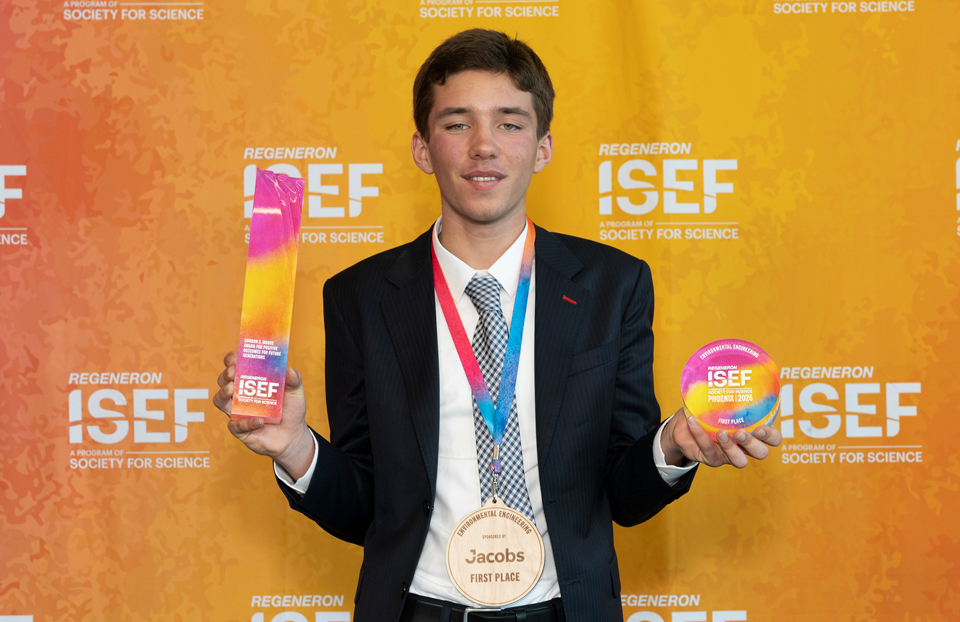
Evan Budz is 15 years old and in Grade 10 at Dr. Frank J. Hayden Secondary School in Burlington.
In May, he left the world's largest youth STEM competition with a $50,000 award for a robot that swims like a sea turtle and uses artificial intelligence to find microplastics in water.
Budz was one of 1,727 finalists from 67 countries, regions and territories at the 2026 Regeneron International Science and Engineering Fair in Phoenix, Arizona. Youth Science Canada says all eight students on its Team Canada delegation received recognition at the event.
Budz received the Gordon E. Moore Award for Positive Outcomes for Future Generations, worth $50,000, as well as the First Grand Award in Environmental Engineering. But the scale of the project itself may be the more surprising part.
What did he actually build?
The problem Budz was trying to solve is difficult to see with the naked eye.
Microplastics are tiny pieces of plastic found in water and other parts of the environment. Existing methods for measuring them can be expensive and difficult to use in the field, according to Society for Science, which runs ISEF.
Budz's solution combines three things: a self-propelled underwater robot, a custom 3D holographic camera and AI models trained to distinguish plastic from other particles.
The robot moves through the water in a way designed to resemble a sea turtle. As it travels, the camera captures three-dimensional images of particles in the water. The AI then analyzes those images and looks for microplastics.
Society for Science says Budz's models were 94 per cent accurate at telling microplastics apart from other particles. They could identify pieces of plastic smaller than a red blood cell.
He tested the system in 10 bodies of water and scanned more than 80,000 3D images containing plastic particles and microorganisms.
That is what turns this from a clever school project into a potentially useful monitoring tool: instead of collecting water, transporting samples and relying only on laboratory analysis, the idea is to make it easier to detect and measure microplastics where they are actually found.
How big is ISEF?
Regeneron ISEF ran from May 9 to 15 in Phoenix. Youth Science Canada describes it as the world's largest youth STEM competition.
The finalists were not all competing for a single prize. ISEF recognizes projects across many scientific and engineering categories and also awards several major prizes. Budz received the $50,000 Gordon E. Moore Award for work that Society for Science says could create positive outcomes for future generations.
His project was formally titled In Situ Microplastic Detection Using Holographic Imaging and AI on an Autonomous Bionic Sea Turtle.
He also received a $2,500 special award from Midjourney and an honourable mention from the International Council on Systems Engineering, according to Youth Science Canada.
The path started closer to home
Before Phoenix, Budz was already competing through the local science-fair system.
The Bay Area Science and Engineering Fair lists Budz as a Dr. Frank J. Hayden Secondary School student and a 2026 Gold Merit Award recipient. He also received a Canada-Wide Science Fair trip award and local engineering awards at that event.
That local-to-international path is part of what makes the result notable for Burlington. A Grade 10 student from a Burlington public high school did not simply attend a large international fair. He left with one of its $50,000 awards for a device designed around a global environmental problem.
And the project is unusually easy to understand once the technical language is stripped away: build a robotic sea turtle, give it a 3D camera, teach an AI system what microplastic looks like, and send it swimming.
The difficult part was making that idea work well enough to stand out among more than 1,700 finalists from around the world.