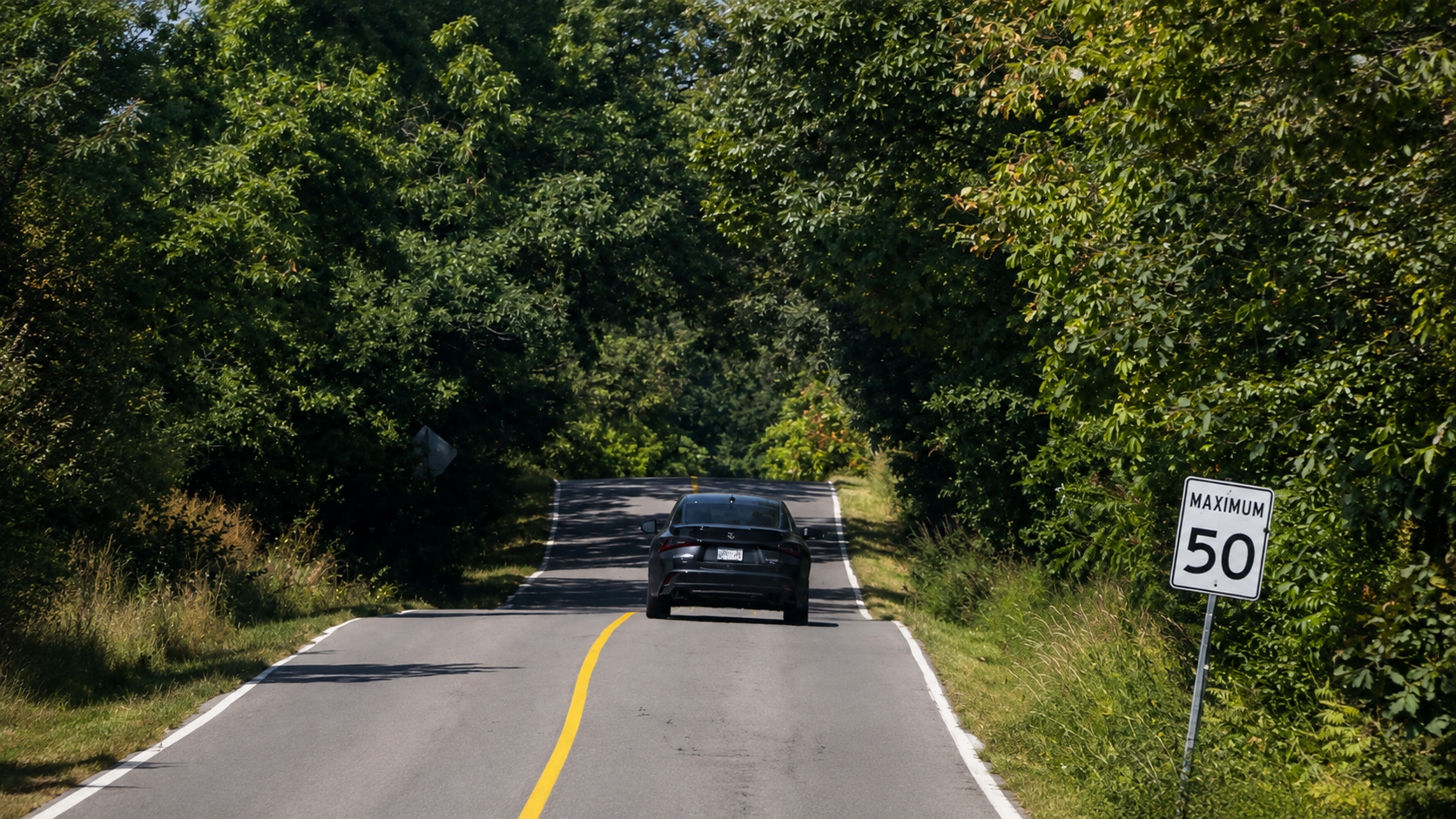
King Road does not look like a place where gravity should become confusing.
It is a narrow, wooded road north of Highway 403. There is no attraction sign, no giant roadside gimmick and no machine hidden beneath the pavement. Yet generations of Burlington drivers have described the same experience: a vehicle seems to move in the direction their eyes insist is uphill.
The story is old enough that Burlington residents were arguing about the cause before most homes had television.
People were already trying to explain it in the 1950s
In a 2016 newsletter, the Burlington Historical Society republished an account written by former member Nora Gilbert in the 1950s.
Gilbert wrote that motorists visited the spot and left wondering what had happened. Some took their cars to garages looking for a mechanical explanation. Others believed the hill was somehow electrified.
That detail matters because it shows the mystery did not begin with an internet video or a modern ghost story. The visual effect was convincing people more than 70 years ago.
It also became part of Burlington's public identity. A Tourism Burlington guide published in 2012 listed Magnetic Hill among the city's attractions and placed it on King Road in rural Burlington.
The road is not magnetic
The strongest explanation comes from research on places usually called gravity hills, magnetic hills or antigravity hills.
In 2003, researchers published a series of experiments in Psychological Science testing why people can see a downhill road as uphill. They changed the slope of a model road, the surrounding landscape and the visible horizon.
The apparent reversal happened when the visual references around the road made people misjudge what counted as level.
In other words, gravity does not change. The observer's reference point does.
Why King Road is so convincing
The King Road scene contains several features that make judging slope difficult. Trees crowd the road. The pavement rises and falls through rolling terrain. A clean horizon is hard to see.
Your brain still has to decide which direction is level, so it uses the surrounding land as a reference. If those cues are misleading, a shallow downhill grade can look like an uphill one.
That produces the part that feels impossible. The car behaves normally while the landscape makes normal motion look wrong.
Burlington News has not independently surveyed the exact grade of the magnetic-hill section, so we are not presenting a precise slope measurement. The documented scientific explanation is the visual illusion itself.
The strange part is how certain it feels
Knowing the explanation does not necessarily make the road look different.
The visual system is not giving you a rough guess. It can create a strong sense that one direction is uphill even while gravity is pulling the other way.
That is probably why the King Road story survived. In the 1950s, people blamed electricity and took cars to mechanics. Decades later, Burlington was still listing the hill as a local curiosity.
The force was never hiding under the road. The trick was in the view.
King Road is narrow and has limited roadside space. This article does not provide instructions for recreating the effect with a vehicle.
We included King Road in our collection of Burlington mysteries, but this is the unusual one with a strong scientific answer.