
A new Burlington factory is trying to move most of the work of constructing a building indoors.
SEKISUI Canada Modular Solutions has established its Canadian manufacturing and operations hub in Burlington through a $15-million investment announced by Invest Ontario on Aug. 19.
The number that makes the project unusual is 90 per cent. The company says its modular process can allow up to 90 per cent of a building to be completed in a controlled factory before the finished sections are assembled on site.
What is actually being made here?
These are not flat wall panels or temporary trailers. SEKISUI describes its system as three-dimensional steel modules: box-like sections of a building that can be manufactured with much of the structure, interior work and building systems already in place.
The modules are then transported to a construction site and connected into the final building.
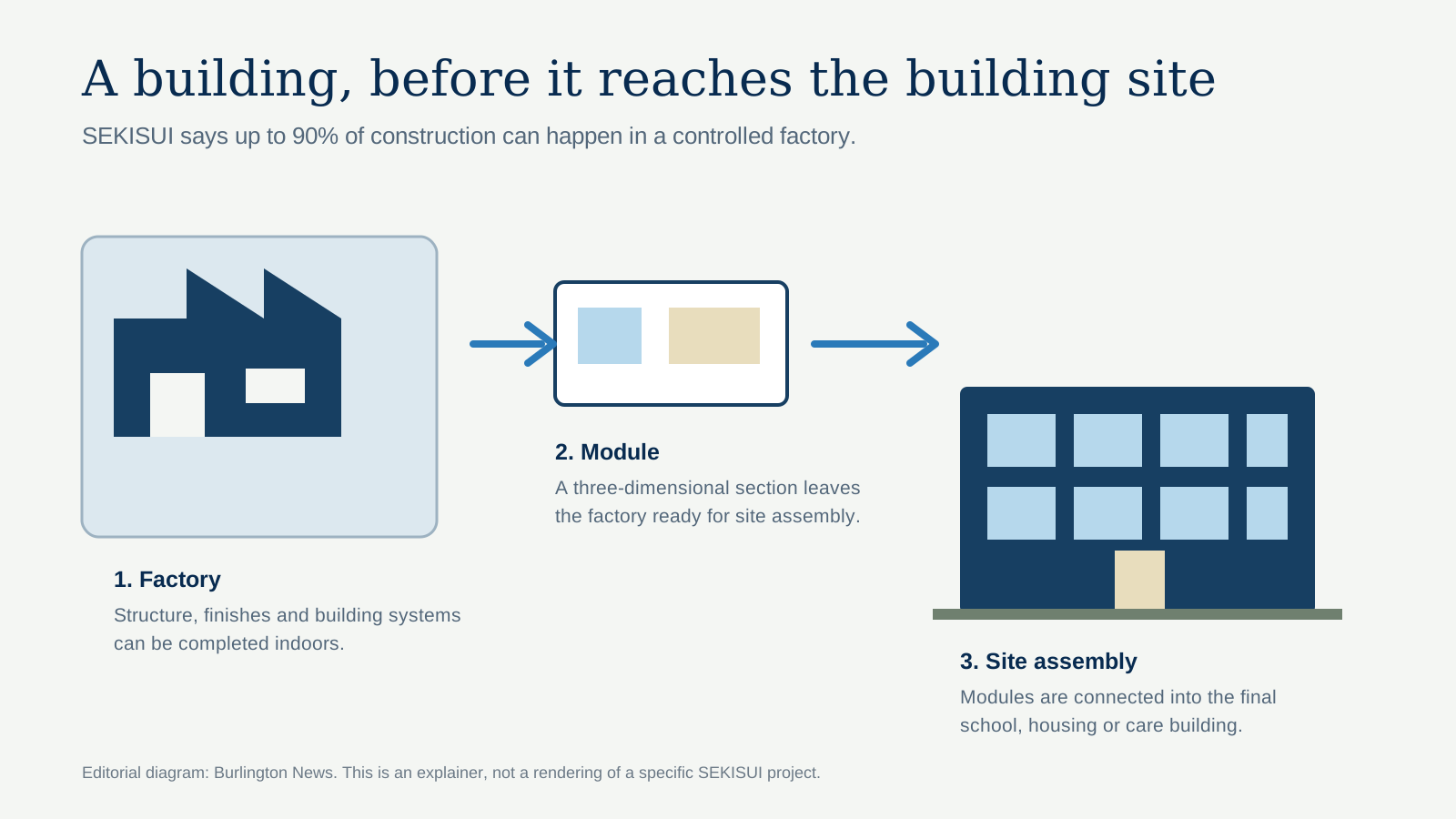
SEKISUI's Japanese parent company said when it established the Canadian business in late 2025 that the first targets would include one- and two-storey schools, four- to eight-storey apartment buildings and care facilities.
Its plan listed annual manufacturing capacity of 500 to 600 modules. The company had expected testing through spring 2026 and full-scale manufacturing to begin around July.
Invest Ontario's Aug. 19 announcement confirms the Burlington hub is now being established as the company's Canadian manufacturing and operations base.
Why build most of a building inside?
A construction site has weather, changing crews, deliveries and work that has to happen in sequence. A factory can repeat the same process under controlled conditions.
That does not mean a building arrives finished and gets dropped onto an empty lot. Foundations, site servicing, connections and final assembly still have to happen where the building will stand.
The change is how much of the work happens before those modules arrive.
SEKISUI says its approach is meant to improve productivity and construction quality while shortening the amount of work required on site. The company is bringing more than 50 years of modular-construction experience from Japan to the Canadian operation.
Why Burlington?
The Burlington location puts the operation inside the Greater Toronto and Hamilton Area, close to a large construction market and major highway connections.
Invest Ontario says the City of Burlington, Toronto Global and Invest Ontario worked with the company as it established its Canadian presence, providing market information, government connections and access to potential partners.
The larger plan is not limited to Burlington buildings. SEKISUI's parent company has said it wants to establish a modular-construction business model in eastern Canada, initially targeting Ontario and nearby markets, and later consider expansion into the United States and western Canada.
That makes this a different kind of Made in Burlington story. The factory is local, but the buildings it supplies may not be.
What we still do not know
The public announcements do not identify the first Canadian project that will use modules from the Burlington operation.
They also do not provide a current local headcount or say how quickly the plant expects to reach its stated capacity of 500 to 600 modules a year.
Those are the next useful measures. A $15-million factory is one milestone. The bigger test will be how many schools, homes and other buildings actually leave Burlington in pieces ready to be assembled somewhere else.