Upper Middle Road and Guelph Line looks like the obvious answer.
It is wide, busy and monitored by a red-light camera. Drivers turning left must judge traffic moving toward them across a major arterial road.
But the latest public collision ranking points farther south. The red-light camera numbers point to a different intersection. A detailed engineering study identifies a third problem only a few blocks away.
The more records Burlington News reviewed, the less this looked like a contest between individual corners.
One road kept appearing.
How we measured it
The newest public collision ranking covers intersections on Halton Region's road network, not every City-controlled intersection in Burlington. It also reports raw collision totals, not the risk of a crash for each vehicle that enters an intersection.
Burlington News compared Halton's 2024 transportation report, 2024 red-light camera results and a 2020 engineering study that analyzed collisions from 2013 through 2017. Those records measure different things across different periods. They reveal patterns, but they cannot be combined into one definitive danger score.
That distinction matters. The busiest intersection can accumulate the most crashes without being the riskiest per trip. A camera total counts violations on one monitored approach, not every driver moving through the intersection. A smaller number of crossing-path crashes can also be more serious than a larger number of low-speed rear-end collisions.
The latest collision leader
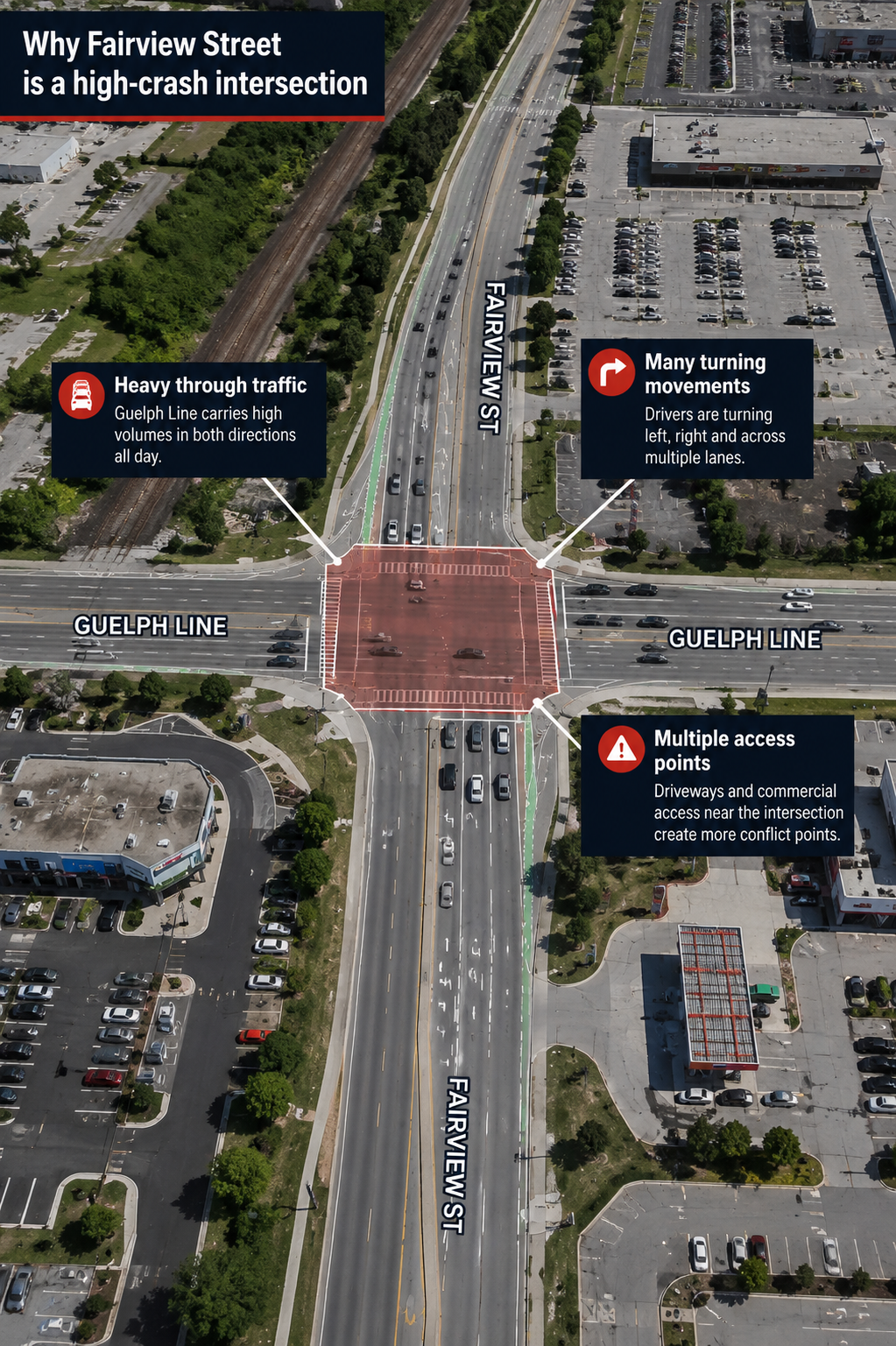
In the latest public intersection ranking, Guelph Line and Fairview Street had the most reported collisions on Halton's regional-road network in 2024.
Burlington recorded 1,077 collisions on regional roads that year. Of those, 131 involved injuries and two were fatal.
The result answers one version of the question. If “worst” means the corner with the highest raw collision count in the newest public ranking, Guelph and Fairview is the answer.
It does not explain why.
The public summary does not show the movements involved, the collision types at that specific intersection or the number of vehicles entering it. Fairview carries heavy commercial traffic, multiple turning movements and a large volume of vehicles, but those features alone do not prove the cause of its 2024 ranking.
To determine whether it is unusually dangerous rather than unusually busy, the collision total would need to be compared with current traffic entering the intersection.
The red-light leader is somewhere else
The camera data points north, to Guelph Line and South Service Road.
Its northbound camera recorded 2,139 red-light violations in 2024, the highest total among Halton's camera locations. Guelph Line and Mountainside Drive recorded 810.
Those numbers require an important warning. Halton's cameras monitor one approach to an intersection. They do not count every red-light runner from every direction, and a location with more traffic passing the monitored camera has more opportunities to record a violation.
Still, South Service Road has appeared repeatedly near the top of the camera data, and an older engineering study helps explain why the intersection is unusual.
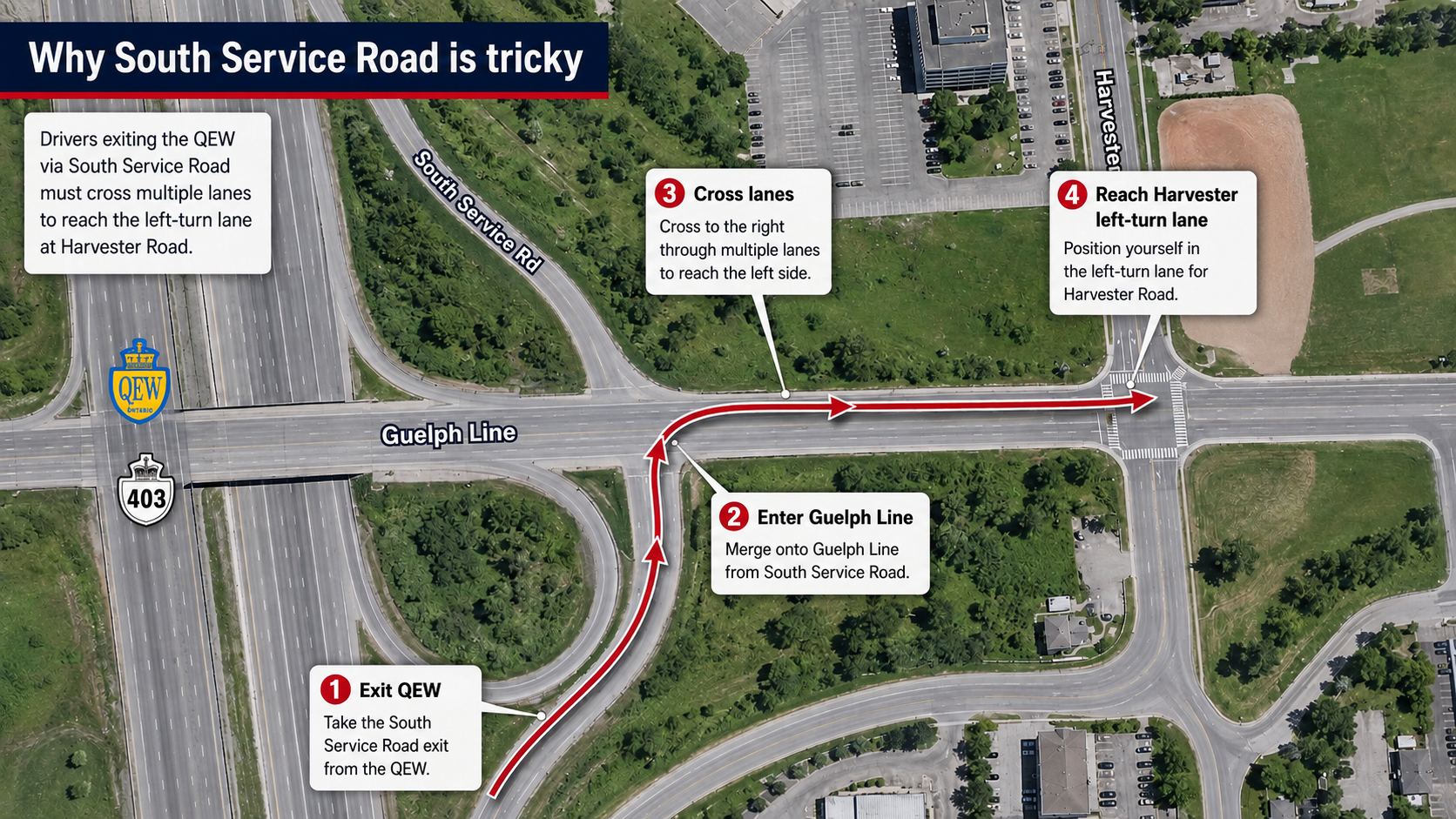
It sits beside the QEW. Drivers leaving the highway meet a signalized arterial almost immediately. The same area also connects with the service road and nearby commercial and employment traffic.
Between 2013 and 2017, Halton's study recorded 28 collisions at the Guelph Line and South Service Road link:
- 15 angle collisions, in which vehicles struck across one another's paths
- nine rear-end collisions
- three sideswipes
- one collision in another category
The study also documented a recurring movement by some drivers leaving the QEW. Instead of continuing toward Harvester Road as directed, they turned onto Guelph Line, crossed southbound lanes and tried to reach the left-turn lane at the next signal.
That required several decisions in a short distance: leave a highway, enter a busy arterial, cross lanes and prepare to turn again.
The historical collision pattern is consistent with an intersection shaped by crossing traffic and compressed decision-making. It does not prove that the same conditions explain every current camera violation.
The intersection that ran out of room
At Guelph Line and Harvester Road, the older study found a different problem.
Halton recorded 115 collisions there from 2013 through 2017:
- 57 rear-end collisions
- 24 turning collisions
- 16 sideswipes
- 10 angle collisions
- eight collisions in other categories
Half were rear-end crashes.
The study found that the intersection was operating beyond its practical capacity during the afternoon rush. Queues on Harvester and Guelph Line sometimes extended toward neighbouring intersections.
Only about 95 metres separated Harvester from the South Service Road signal near the QEW. The study found that this space could not reliably hold the combined through and left-turn queues.
That operating pattern is consistent with the collisions in the record. Vehicles reach the back of a queue sooner than expected. Some stop sharply. Others change lanes to escape it. Rear-end and sideswipe crashes become more likely.
Halton marks the environmental assessment as completed, meaning the study process concluded in 2020. The public project page does not establish that every recommended physical improvement has since been constructed, and the detailed collision figures are not current enough to describe the intersection today without qualification.
What the study provides is a rare explanation of how a busy intersection can fail without one dramatic defect. Sometimes there is simply more traffic and more queue than the available road can hold.
What about Upper Middle and Guelph?
Upper Middle and Guelph remains a legitimate place to investigate.
It is one of Burlington's five current red-light camera locations. Three of those five are on Guelph Line: South Service Road, Mountainside Drive and Upper Middle Road.
But the records reviewed for this article do not identify Upper Middle and Guelph as Burlington's latest collision-count leader or Halton's latest camera-violation leader.
They also do not identify a blocked sightline as a confirmed cause of crashes there.
A left-turning driver may misjudge the speed or distance of an approaching vehicle on a broad arterial road. That is a plausible conflict, especially when a vehicle is moving faster than expected. It is not evidence of a visibility defect.
Answering that question properly would require current collision diagrams, approach speeds, signal timing and records showing which movements were involved.
The pattern hiding in plain sight
By this point, the same road has appeared in every category:
- Guelph and Fairview led the latest public intersection collision ranking.
- Guelph and South Service led the 2024 red-light camera totals.
- Guelph and Harvester had a documented queueing and rear-end problem.
- Guelph and Mountainside also ranked near the top of the camera results.
- Guelph and Upper Middle is another camera-equipped intersection on the corridor.
Guelph Line is a major arterial road. Its job is to carry large volumes of traffic, serve trucks and regional trips, and connect drivers with the QEW. Within a short distance, it must also handle retail traffic around Fairview, employment traffic around Harvester, highway ramps, service roads, residential cross streets, buses, pedestrians and turning vehicles.
The road keeps changing jobs.
At Fairview, the warning sign is the total number of collisions.
At Harvester, the historical problem was traffic and queues exceeding the space available.
At South Service Road, the warning signs are red-light violations, a highway connection and a historical concentration of crossing-path collisions.
Farther north, the concern shifts toward long approaches and difficult turning decisions.
That is why two drivers can name different “worst” intersections and both be reacting to something real. They may be describing different types of risk along the same corridor.
So which intersection is the worst?
If “worst” means the most reported collisions in the latest public intersection ranking, the answer is Guelph Line and Fairview Street.
If it means the most red-light camera violations in 2024, the answer is Guelph Line and South Service Road.
If it means the clearest documented congestion problem, the strongest public explanation is the older study of Guelph Line and Harvester Road.
They are not the same failure. One reflects collision volume. One reflects violations on a monitored camera approach. One reflects an intersection that ran out of room during the afternoon rush.
The public data cannot yet tell Burlington drivers which intersection carries the greatest risk on each trip. Halton says detailed 24-hour traffic counts and intersection turning counts are available by request, but those figures are not included in the annual public ranking.
It does show where Burlington's most visible intersection problems repeatedly meet.
Guelph Line.